









Contents
Cement and concrete plants use a range of drive arrangements, from mills to conveyors and from pumps to industrial fans. Coupling selection depends not only on the application but also on the drive speed, whether a gearbox is present, and whether braking or overload protection is required.
Starting the selection from the application
It is not possible to assess every drive point in a plant in the same way. The operating patterns of mill, crusher and separator drives differ from those of conveyor, fan and pump applications. The position of the gearbox in the system and whether the drive speed is high or low are also key factors in coupling selection.
For this reason, the selection process should start by defining the application and the drive arrangement; the roles of components such as couplings, torque limiters or brakes in the system should then be considered together.
Mill, crusher and separator drives
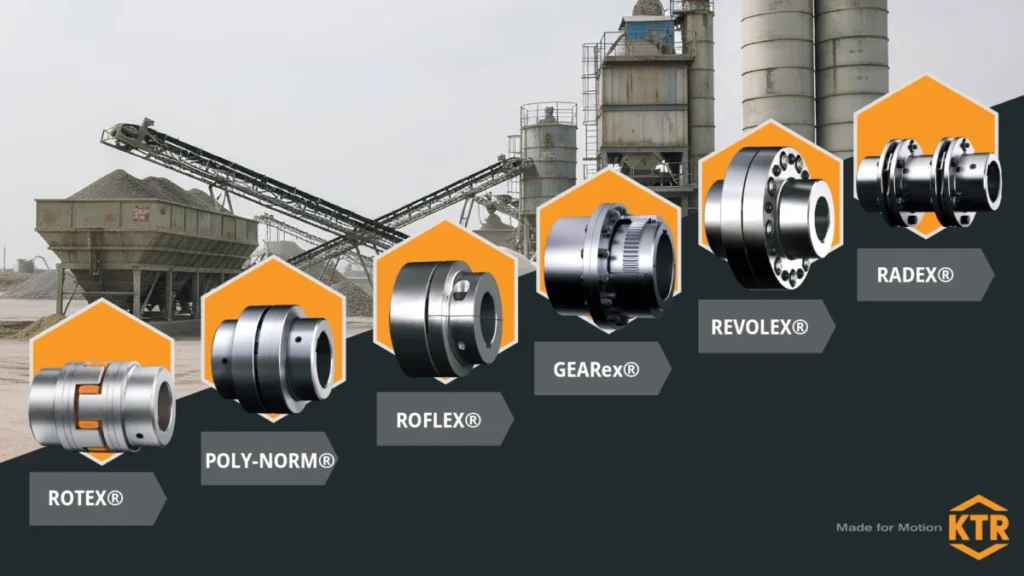
For mill, crusher and separator drives with or without a gearbox, the range of suitable couplings varies according to the drive speed. ROTEX®, POLY-NORM® and ROFLEX® solutions stand out for high-speed drives, while GEARex®, REVOLEX® and RADEX® come to the fore for low-speed drives. In both speed groups, a torque limiter can be considered as part of the overload protection requirement of the drive train.
The key point here is not to select a coupling solely on the basis of the application name. The appropriate solution should be determined by evaluating the drive speed, the gearbox arrangement and the protection requirements of the system together.
Power transmission and braking in geared conveyors
Conveyor drives also offer different coupling alternatives for high- and low-speed arrangements. ROTEX®, POLY-NORM® and ROFLEX® stand out on the high-speed side, and GEARex®, REVOLEX® and RADEX® on the low-speed side.
In conveyor applications, braking requirements are part of the design alongside power transmission. KTR brakes and brake discs are therefore also among the system components for both speed groups.
Different options for fan and pump drives
REVOLEX® and RADEX® are among the coupling families that can be considered for direct-drive industrial fans.
For pump drives with or without a gearbox, the options vary by speed group. ROTEX®, POLY-NORM®, ROFLEX®, RADEX® and GEARex® are the leading alternatives for high-speed applications, and GEARex®, REVOLEX® and RADEX® for low-speed applications. This variety means that speed and system arrangement must be taken into account together when selecting couplings for pump drives.
POLY-NORM®-M for vertical and ball mills
POLY-NORM®-M forms a separate application area for vertical mills and ball mills. For these drives, the product should be evaluated on the basis of the mill arrangement and the system requirements.
Assessing the drive train as a whole
In cement and concrete plants, coupling selection is not simply a product comparison. Application type, gearbox arrangement, drive speed and the need for overload protection or braking must be considered together. Incorporating torque limiters in mills, crushers and separators, and brakes and brake discs in conveyors, makes the design of the drive train more holistic.
This approach ensures that different coupling families such as ROTEX®, POLY-NORM®, ROFLEX®, GEARex®, REVOLEX®, RADEX® and POLY-NORM®-M are assessed according to the actual drive arrangement within the plant, rather than being assigned to every application in the same way.
Source and image: KTR

Author
Güç Aktarım


 Güç Aktarım (Power Transmission)Güç Aktarım · Ekim 2026Read the latest issue free →