














Contents
Spherical roller bearings are designed for demanding applications. Thanks to their construction, they can carry heavy radial loads, handle radial and axial loads simultaneously and tolerate misalignment between the shaft and the housing. Knowing how these features work makes a difference in bearing selection.
How are heavy loads carried?
There is no single load value that defines a heavy-load application. Because load capacity varies considerably with bearing size, what counts as a heavy load depends on the bearing being assessed. The actual radial and axial loads need to be compared with the ratings of the bearing in question. Three basic load cases stand out here:
- A radial load acts perpendicular to the shaft.
- An axial (thrust) load acts along the shaft.
- A combined load applies radial and axial forces to the bearing at the same time.
Spherical roller bearings are particularly advantageous in applications with high radial loads or with radial and axial loads acting together.
Whereas typical ball bearings have a single row of rolling elements, spherical roller bearings use two rows of rollers. The roller geometry, roller size and the contact angle between the rollers and the raceway determine load capacity. The angle at which the rollers contact the raceway helps the bearing carry axial loads as well as radial loads. How much load the bearing can carry depends on its size and design.
A self-aligning design tolerates misalignment
Load capacity is only one aspect of spherical roller bearings. Another important feature is their ability to accommodate misalignment. The spherical profile of the rollers and raceways allows the inner ring and roller assembly to move while remaining in contact. This self-aligning design tolerates alignment deviations that could cause problems in other bearing types, making the bearing more forgiving where not everything in the application is perfectly aligned.
Misalignment can occur in different ways. Static misalignment is a fixed alignment condition that exists before the equipment starts operating. Angled mounting surfaces, offset bolt holes or a misaligned housing are examples. Dynamic misalignment covers changes in alignment that occur during operation. Shaft deflection can cause alignment to change during operation, and the self-aligning design of the spherical roller bearing helps accommodate these changes.
However, being self-aligning does not mean alignment no longer matters. How much misalignment a bearing can accommodate depends on its design. Self-alignment adds tolerance to the application, but the bearing still needs to be selected and mounted according to the requirements of the equipment.
Mounted spherical roller bearing options
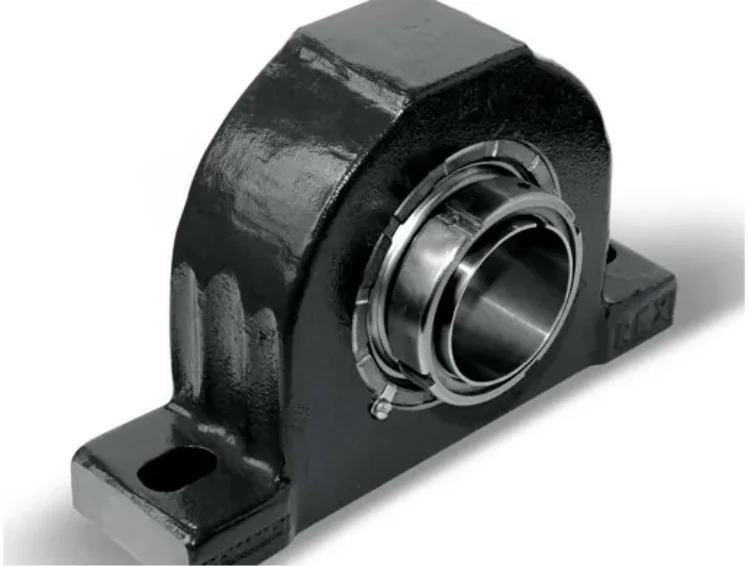
Once it has been established that a spherical roller bearing is suitable for the application, the next step is to determine the housing, sealing, shaft attachment and other configuration options that best suit the operating conditions. Mounted spherical roller bearings are offered as pillow block, flange, take-up and cartridge housed units. Pillow blocks are available with one-piece and split housing options.
The operating environment is decisive in choosing the right seal. Seals keep lubricant in and contaminants out; the appropriate choice depends on the level of contamination, the operating speed and ambient conditions. How the bearing is attached to the shaft is as important as the bearing itself. Setscrew locking can cause problems in high-vibration conditions; in such cases a different method, such as tapered adapter locking, may be more suitable. Rather than treating the bearing, housing, seal and shaft attachment as independent decisions, it is recommended to select a complete bearing configuration for the application.
Which industries use them?
Mounted spherical roller bearings are widely used in heavy industry where high loads and harsh conditions are common:
- Mining and metals: heavy industrial equipment operating under high loads and harsh conditions.
- Cement and aggregates: severe operating conditions with high radial and axial loads.
- Forestry and wood processing: high radial loads, shaft deflection, misalignment and shock loads.
- Grain processing and material handling: bucket elevators, screw, belt and drag conveyors, mixers, hammer mills and dryers.
How to choose the right bearing
Choosing the right spherical roller bearing starts with understanding the application. While shaft diameter is the first factor, load, speed, temperature, contamination, vibration and lubrication requirements also influence the most suitable bearing and configuration. Start by determining the required shaft diameter and calculating the radial and axial loads the bearing will carry; if both loads occur at the same time, they should be considered together.
The fact that an application requires high load capacity does not on its own make a spherical roller bearing the best option. If the required operating speed exceeds the bearing’s rating, another bearing design may be more suitable. Seals also have different speed limits, so these should be checked when selecting seals.
How the shaft and housings will actually behave in the equipment should also be assessed: static misalignment, alignment changes during operation, shaft deflection, the alignment of mounting surfaces and the suitability of the shaft for the locking method. A good selection treats the bearing not as a standalone component but as part of the operating system.
Contamination and environmental conditions affect seal selection and relubrication intervals. In grain applications, bearings can be exposed to fine dust, so protection against contamination becomes an important sealing criterion. In forestry applications, bearings may encounter sawdust, bark, resin, moisture, ash and heat. Operating temperature, nearby heat sources and vibration also influence the selection; high-vibration applications may require changes to the bearing configuration.
When is another bearing design more suitable?
Although spherical roller bearings are versatile, they are not automatically the best option for every demanding application. Where very high axial loads require more thrust capacity, a tapered roller bearing may be a better choice. Where the required speed exceeds the spherical roller bearing’s rating, a heavy-duty ball bearing may be more suitable. In cases of insufficient load, rolling element bearings need enough load for the rollers to roll smoothly rather than skid. The right bearing is the one selected according to all the operating requirements of the application.
Regal Rexnord solutions
Regal Rexnord offers mounted spherical roller bearings with different shaft diameters, shaft attachment types, seals and housing options such as pillow block, flange, take-up and cartridge. Rex and Link-Belt mounted spherical roller bearings feature a wide, two-piece outer ring design that makes room for larger rollers for higher load ratings. Thanks to its wide contact angle, this design provides high thrust capacity, adjustable internal clearance, field-replaceable seals and static and dynamic misalignment tolerance of up to ±2°.
Jason Ludwig, Senior Engineering Manager at Regal Rexnord, contributed technical information and application experience to this article.

Author
Güç Aktarım


 Güç Aktarım (Power Transmission)Güç Aktarım · Kasım 2026Read the latest issue free →