










Contents
- Hello, Mr İsmail. Could you introduce yourself and tell us how you came to choose the recycling sector?
- Could you tell us about the development of GCM Geri Dönüşüm?
- Could you tell us about GCM Geri Dönüşüm’s fields of activity?
- From your perspective, how do you assess the interest in recycling within Turkish industry?
- Do you carry out production for applications shaped by requests from your customers?
- How do you analyse the needs of the market?
- In which sectors of recycling is GCM Geri Dönüşüm active?
- Could you tell us about the importance of plastic recycling?
- How do you assess the recycling sector and recycling awareness in Türkiye?
- Could you tell us what kind of R&D work you carry out on environmental recycling machines?
- What should Turkish industry do to be environmentally responsible for a sustainable environment, and what are you doing in this regard?
- What is your most beneficial application for your customers in terms of efficiency?
- Could you take us through the recycling of plastic in your Plastic Recycling Line from start to finish?
- What power transmission components (gearboxes, bearings, motors, chains, belts, ball screws, sensors, etc.) do you use in your Plastic Recycling machines?
- Which of your products attract the most interest in the plastics sector in Türkiye?
Hello, dear readers. We all know that GCM Geri Dönüşüm produces efficient recycling machines with customer-focused solutions. We visited this innovative recycling machinery manufacturer on site, gathered information from them about the recycling sector and have tried to share it with you.
In this context, we had an enjoyable conversation with İsmail Pınarlı, Sales and Marketing Manager at GCM Geri Dönüşüm, about the past, present and future of the GCM Geri Dönüşüm brand. We would like to thank them for their hospitality and for answering our questions about the recycling sector. We now leave you with this pleasant interview.
Hello, Mr İsmail. Could you introduce yourself and tell us how you came to choose the recycling sector?
I graduated from Şişli Industrial Engine Vocational High School in 1984. I entered this sector by chance; from the day I started, I came to love recycling with GCM Makina, and I still do my job with pleasure. For the past 10 years I have been responsible for the recycling machinery sales department.
Could you tell us about the development of GCM Geri Dönüşüm?
Founded in 1988 as GCM Makina, our company first became a leader in the domestic market thanks to its quality and customer-focused after-sales services, and over time we have come to export to more than 30 countries. We have a broad customer portfolio. As Güven Çelik, we have brought together our knowledge and experience under GCM Group. We operate under the GCM brand in textile machinery and the GCM Geri Dönüşüm brand in plastic recycling, and we carry out our automation and software work in-house.
Could you tell us about GCM Geri Dönüşüm’s fields of activity?
We currently work in the fields of textile machinery, textile automation and quality control machinery. As GCM Geri Dönüşüm, we have been active in the recycling sector for 4 years. We are still considered relatively new to recycling; we work with a focus on customer satisfaction, which is why our customers are satisfied with us. As GCM Geri Dönüşüm, we currently produce machines for the plastic recycling sector; we are not considering entering other recycling machinery sectors such as metal and steel. Our aim is to advance ourselves in plastic recycling machinery.
From your perspective, how do you assess the interest in recycling within Turkish industry?
Speaking as GCM Geri Dönüşüm, our recycling sector is advancing very rapidly. This progress is also reflected in our sales: our domestic sales are in good shape, and whereas we previously could not sell machines abroad, we are now seeing demand and selling machines there.
Do you carry out production for applications shaped by requests from your customers?
We have products in our standard catalogues, but we can make modifications to the standard in line with special requests from our customers. As we are a customer-focused company, we are able to work flexibly on our products.
How do you analyse the needs of the market?
We study markets abroad and our own sector, and building on this, and because we work closely with our customers, we are able to analyse the needs of the market. Our customers are always our guide in identifying the needs in our sector. We carry out production and R&D work aimed at meeting these needs.
In which sectors of recycling is GCM Geri Dönüşüm active?
As GCM Geri Dönüşüm, we currently produce machines for the plastic recycling sector; we are not considering entering other recycling machinery sectors such as metal and steel. Our aim is to advance ourselves in plastic recycling machinery.
Could you tell us about the importance of plastic recycling?
As you know, plastic products are derived from petrochemicals, and since we are dependent on imports in this area, failing to recycle them causes economic harm; in addition, because plastic is a petroleum waste, it does not break down in the soil when discarded into the environment and pollutes it. The more recycled plastic products we produce, the more we can prevent the price of plastic products on the market from rising – in other words, we reduce purchases of petroleum raw materials.
How do you assess the recycling sector and recycling awareness in Türkiye?
Interest in the recycling sector in our country is good, but the plastics collected on the market could be cleaner. People need to be made more environmentally aware; it is essential to create awareness about separating plastics, glass and paper. The biggest problem in plastic recycling is washing and cleaning. To obtain higher-quality plastic granules, clean plastic recycling waste must be used. Plastics collected from rubbish become contaminated because they are mixed, and even if they are washed and cleaned during recycling, the fact that they are not collected separately and cleanly reduces the quality of the granules. Waste separation needs to be practised and made widespread by both our public and our state. When our municipalities collect waste separately and pass it on for recycling, the process speeds up, and because there are no intermediaries, the price of plastic also falls. To build this awareness, we need to teach recycling awareness to our children, starting from primary school.
Could you tell us what kind of R&D work you carry out on environmental recycling machines?
At GCM Makina we attach importance to R&D; every day our R&D work on the recycling sector and our efforts to take ourselves further continue. If we do not work in R&D and stay one step ahead, we will fall behind. At present our R&D is focusing particularly on filters. We are working on the automatic self-cleaning filters used in recycling machines.
What should Turkish industry do to be environmentally responsible for a sustainable environment, and what are you doing in this regard?
As you can see in our office, we separate our paper, glass, iron and plastic waste before disposing of it. To be frank, we support the environment and recycling by starting with ourselves. I believe other companies should also start with changes from within.
What is your most beneficial application for your customers in terms of efficiency?
Most of our customers have previously been in the recycling sector, meaning they are not companies doing this work for the first time, but after a certain number of years they renew their machines so as not to fall behind and to be able to compete in the market. They are satisfied with the Shredder and Granulation Lines and machines we have sold so far; even though we sell machines with a capacity of 500-600 kilograms, our customers are able to achieve outputs of 700 to 800 kilograms. As we are a machinery manufacturer, problems can occasionally arise, but with our expert team we provide engineering services as quickly as possible and ensure that our customers’ operations continue in the shortest possible time.
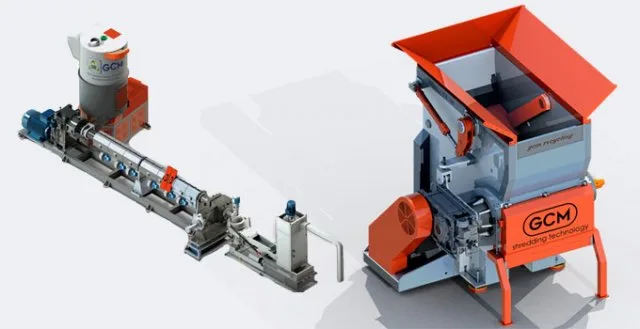
The Complete Recycling Line consists of 2 sections: Section 1 is the WASHING line and Section 2 is the Granulation Line.
Could you take us through the recycling of plastic in your Plastic Recycling Line from start to finish?
First of all, the plastic collected from the market – and this could also be paper or metal – goes to recycling companies. The plastic is collected by companies providing plastic recycling services and sorted by type (PE, PP, HDPE, LDPE, HDPE, etc.). Essentially, the recycling line consists of two sections: the washing line and the granulation line. The sorted plastics pass through the washing line and the granulation line. To explain these processes: because the incoming plastics are dirty, they are first broken up with a Shredder or plastic crushing machine and reduced to small pieces (down to 1 to 1.5 cm); these small pieces then go to our centrifuge machines, and after the high-speed centrifuge they go to the tank, where the plastics separate according to their density: plastics such as polyethylene and polypropylene remain at the surface, while contaminants (PET, soil, etc.) sink to the bottom and are thus separated out. In the tank system, contaminants are separated using the decantation (flotation) technique. After being washed here, the material goes on to drying. Two types of machine are used for drying. One is our vertical centrifuge machine, while the other dries lower-grade film-type plastics such as polyethylene; after drying, the particles are fed into a silo and from there passed to the Agglomerator (Agromel) Machine. The main function of the Agglomerator in plastic recycling is as follows: the material is heated up to melting point, after which the contaminated gases inside the particles are released and the density of the plastic is increased. The Agglomerator is of great importance for the next stage, the Granulation line, because the contaminated gas is removed from the plastic material and its density is increased, thereby improving the quality of the plastic; when it enters the granulation machine, instead of obtaining 500 kg of plastic per hour, 650 kg per hour can be produced thanks to the Agglomerator. After the Granule Cutting line, the plastic melts in the Screw & Barrel section, and the molten plastic is cleaned by passing through a filter. After passing through the filter, the cleaned plastic moves to the granule cutting machine, and the plastic, now divided into smaller pieces, is cooled in water. The cooled plastic then goes through drying again (Centrifuge Machine). As the final step, the dried plastics are collected in a silo, resulting in high-quality plastic ready for shipment and use.
What power transmission components (gearboxes, bearings, motors, chains, belts, ball screws, sensors, etc.) do you use in your Plastic Recycling machines?
For gearboxes, we continue to work with Yılmaz Redüktör until something better comes along, and for motors our preference is the GAMAK brand. For bearings, we use SKF or FAG. We always use high-quality materials in the machines we manufacture; even when we buy steel, we use certified steel, both because of our quality standards and because we produce machines that will not let the customer down or disrupt their production. In short, I can say that we produce efficient machines that will satisfy our customers.
Which of your products attract the most interest in the plastics sector in Türkiye?
Shredders and granulation machines (extruders); in addition, there are customers both in Türkiye and abroad who want our machines installed as a complete plant, and we carry out such installations as well.
Shredder machine
Prepared by
Hamza Efe
Editorial Management

Author
Güç Aktarım


 Güç Aktarım (Power Transmission)Güç Aktarım · Kasım 2026Read the latest issue free →